Research
Our research focuses on developing and applying data- and physics-driven tools to accelerate the computational discovery and simulation of functional materials, bridging theoretical models closely to experimental reality.
While our scientific directions naturally evolve alongside new developments in the field, our current efforts center on the following research areas:
AI-guided Workflows for Materials-Discovery and Simulations
Data-driven approaches have emerged as powerful tools for predicting, simulating, and discovering new molecules, materials, and chemical processes. However, their practical deploymentt requires seamless integration with computational simulation frameworks, together with robust model architectures, efficient learning strategies and automated workflows. Our research aims to develop AI-guided computational workflows that integrate AI/ML methods with atomistic simulations to accelerate scientific discovery. A central focus is the development of data-efficient, reliable, and interpretable models that can operate under data-limited conditions and remain robust in out-of-distribution settings. Our work includes the development of scientific datasets, machine-learning force fields, automated simulation workflows, and adaptive learning strategies, together with algorithms for adaptive exploration and molecular, materials, and process optimization. Through these approaches, we aim to develop computational methods that are not only predictive, but also reliable, transferable, and practically deployable for scientific discovery.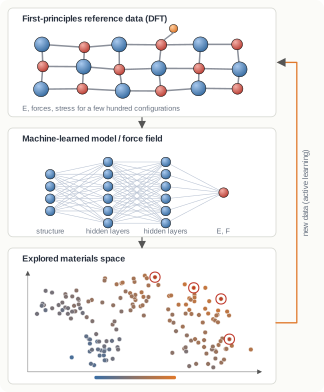
Multi-Scale Modelling of Energy Materials
Computational modelling has greatly accelerated the design of energy materials, but often relies on idealized structures and conditions that differ substantially from realistic operating environments. In practice, materials are inherently heterogeneous and dynamic, with disorder, defects, interfaces and structural transformations that can strongly influence their stability and performance. Our research aims to bridge this gap by developing multi-scale simulation frameworks that capture atomic-scale dynamics and realistic thermodynamic, electrochemical, and environmental conditions. We combine ab-initio approaches, atomistic thermodynamics, statistical mechanics, and machine-learning methods to understand material stability, phase transformations, and functional properties under operating conditions. Our target applications include photovoltaic and compositionally complex materials, with the broader goal of connecting atomistic mechanisms to device-scale performance and materials stability.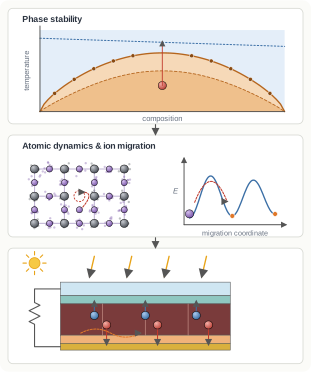
Quantum Computing Applications in Materials
In close collaboration with the Quantum-enabled Computational Discovery Lab (QCDL) led by Dr. Soujanya at CSIR-IICT, we are exploring the frontier of quantum computing in computational chemistry. Critical challenges in energy and catalysis such as transition-metal centers, variable oxidation states and bond-breaking events are driven by strongly correlated electrons that approximate methods like Density Functional Theory often fail to capture reliably. While quantum computers offer a revolutionary approach to solving the electronic Schrödinger equation for these systems, current hardware remains noisy and limited in scale. To bridge this gap, our joint research focuses on developing hybrid classical–quantum workflows. We leverage classical first-principles and embedding techniques to define compact, chemically meaningful active spaces, reserving powerful quantum algorithms like variational quantum eigensolvers and quantum phase estimation, specifically for the correlated core of the problem. We systematically benchmark accuracy, qubit counts, circuit depth, and measurement costs against classical references, while actively developing error-mitigation and resource-reduction strategies optimized for near-term devices. Our final goal is to employ these methods in automated materials discovery pipelines.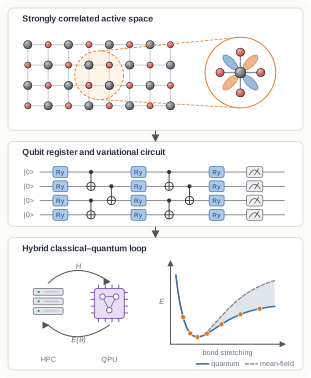
Crystal Structure Prediction
Predicting the crystal structure of a material is a deceptively challenging problem because of the enormous combinatorial space of possible atomic arrangements and the often small energetic differences between competing structures. Yet crystal structure is one of the fundamental determinants of a material’s properties and functionality, making its prediction central to computational materials and molecular discovery. Our research develops and applies crystal structure prediction (CSP) and inverse-design strategies to identify structures that are not only thermodynamically viable, but also tailored towards desired properties and functions. We investigate this challenge across three complementary regimes: inorganic crystals, hybrid organic–inorganic materials, and molecular crystals.By combining principles of crystallography with evolutionary algorithms, atomistic simulations, and on-the-fly multi-fidelity approaches, we efficiently explore complex structural and potential-energy landscapes while balancing computational accuracy and cost. Our applications span materials discovery, molecular and pharmaceutical crystal design, and functional materials, with the broader goal of developing predictive approaches that can guide experimental synthesis and accelerate the discovery of new crystalline materials.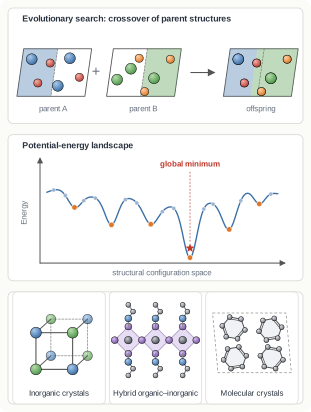
Nanoclusters
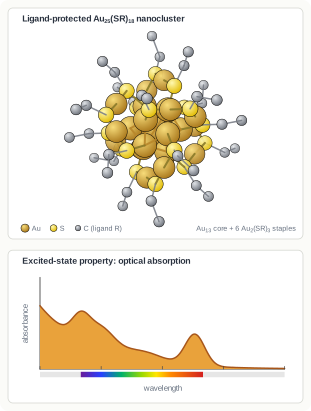
Atomically precise nanoclusters represent a distinctive class of functional materials in which properties can change dramatically with atomic composition, size, charge state, and geometric structure. Their precisely defined atomic structures provide an exceptional platform for establishing fundamental structure–property relationships and understanding how electronic, optical, magnetic, and catalytic properties emerge at the nanoscale. Our research combines atomistic modelling, and data-driven approaches to understand and predict the structure, stability, dynamics, and excited-state properties of ligand-protected metal nanoclusters and cluster-assembled materials. A central objective is to develop predictive frameworks for the discovery and design of novel cluster and cluster-assembled materials, integrating accurate electronic-structure calculations with machine learning and data-driven exploration of the accessible materials space. By connecting atomic-scale structure and dynamics across different length and time scales, we aim to uncover design principles for the rational development of atomically precise nanomaterials. Our applications include heterogeneous catalysis, optoelectronics.